Why “Minds Aren’t Magic”?

A lot of people straightforwardly believe that minds are magic: that our decision making is not simply the result of electricity and biochemistry in neurons and synapses in the brain, but at the core is the product of an immortal soul. This, of course, I reject. But it seems to me that a lot of people who ostensibly do not believe this still seem to unconsciously have something like an immortal soul in their model of the world.

I first noticed this when trying to discuss cryonics with people. “Dead is dead”, they would say, “what on Earth makes you think you can resurrect the dead?” Talk of “resurrection” implies that cryonics is making a magical claim, and this idea arises because death itself is understood to be magical and therefore reversible only by magic. If you understand that brains are machines, you can infer that there is no moment that the soul leaves the body; death is a process through which ultimately the information stored in the brain that makes memory and personality is permanently destroyed, and cryonics attempts to halt that process.

It arises in discussions of criminal culpability. We say Phineas Gage was not responsible for his bad behaviour, because it was the result of a railroad spike through his skull, and then forgive another because of their bad genetic heritage and a third because of their upbringing; but ultimately such an an account of culpability is trying to figure out whether there is mens rea in the immortal soul. As Joshua Greene and Jonathan Cohen argue, such a system cannot survive our increasing understanding of the causes of behaviour; if we are to rescue the ideas of blame and responsibility, as I think we must, we need an account that applies to behaviour whose causes we understand.

And it arises in discussion of AGI, where people seem to want to discuss whether a machine can truly be intelligent, or conscious, or a moral patient, as if we didn’t already have the existence proof that we are precisely such machines.

In practice this blog has not mostly been about this topic but about whatever I happen to be thinking about. But rejecting dualism, and looking for surprising consequences like the above which follow from that, has shaped how I see the world so much that I could not resist it as a title.

Updated 2025-11-08: clarified the third paragraph by appending “if we are to rescue…”

The Paul way to get started with Python

This is really just for a friend on Facebook who knows someone who’s learning Python, but I thought I might as well put it in the world. I think a lot of beginner tutorials for Python start you off on the wrong foot—they recommend a second-rate editor, or start off with bad practices. Here’s my list of ways to get started on the right foot. This is aimed entirely at Windows users.

Step 1: Install development tools

Windows has a tool called winget which saves you a lot of browser clicking to install the tools you need. Right-click the Start button and select “Terminal (Admin)”. Paste in these commands:

winget install --id=astral-sh.uv
winget install Microsoft.VisualStudioCode
winget install Git.Git

Close PowerShell. Note that you don’t need to install Python—uv does that for you when the time comes.

Step 2: Start VS Code and create a Python program

VSCode should now be in the Start menu; start it and maximize it. Select File > Open Folder… to open a folder (or press Ctrl-K Ctrl-O). We want to create a new one, so click “New Folder”. Let’s call the new folder “first-python-project”. You are the author and the folder is empty, so select “Yes, I trust the authors”.

We need to set this folder up for Python programming, so select View > Terminal to open a terminal, and enter the below.

uv init .
uv sync

Wait for that to finish. Now go to File > New File… and create a file called hello.py. The .py extension tells VS Code that this is a Python file. Once you’ve created it, you’ll see a prompt asking if you want to install the recommended Python extension—say yes. Enter the following short program.

print("Hello world")

Step 3: Run your program

Make sure hello.py is open in the editor. Click the “Run Python File” button (▶️) in the top-right corner of VS Code. VS Code will take a moment to understand your Python setup, but soon you should see your hello world message in the terminal at the bottom of VS Code.

Step 4: Save your work with git

Professional programmer advice: programmers use version control to make a record every time they get something working. Select View > Terminal to open a terminal, and configure the version control system Git with the metadata about you that should accompany the work you do on your program, so you get credit/blame for your work:

git config --global user.name "Your Name"
git config --global user.email "your.email@example.com"

Down the left hand side of the window, you should see various icons including a magnifying glass. One of them will be a kind of branching structure, and if you hover over it, it says “Source Control”. Click on this, or press Ctrl-Shift-G. You’ll see “pending changes” – this will include your new file hello.py as well as several other files that are there to manage your Python environment. You want to save them all. Hover over the bar that reads “Changes” and click “+” to “stage” your changes. In the “Message” field at the top, write a message like Wrote hello.py and press Ctrl-Enter. Now your changes are saved—if you break something, you can see everything you changed in this view.

Step 5: Add an external library

Much of the power of Python comes from the many modules that already exist for various jobs. A lot of good modules are bundled with Python, but zillions more are out in the world waiting to be used. Let’s use one: the “requests” library, for accessing stuff over the web. Go to View > Terminal and type

uv add requests

This updates your pyproject.toml file with the new dependency. Let’s write a program that uses it: select File > New file… and create a new file called joke_fetcher.py with this code:

import requests

print("Getting a programming joke from the internet...")

joke_api = "https://official-joke-api.appspot.com/jokes/programming/random"

response = requests.get(joke_api)
joke_data = response.json()

print("Here's what came back from the API:")
print(joke_data)

Run your joke fetcher using VS Code’s run button: make sure joke_fetcher.py is open in the editor and click the “Run Python File” button (▶️) in the top-right corner. A joke, probably extremely weak, will appear in the terminal window, with a setup and punchline.

Something is working, so let’s save your work again: go to the Git view as before, put Add joke_fetcher.py in the “Message” field, and press “Commit”. It will complain that you haven’t staged anything; just say “yes, stage everything” and commit. Now you have a record of your whole project, both before you added the joke fetcher, and after.

Professional programmer advice: because you used uv to install requests, it’s recorded in your source code that it’s needed. specifically in the file pyproject.toml. If you give someone else your source code and they run it the same way, “requests” will be fetched automatically in order to run your program—the same version of “requests” you used, and indeed with the exact same version of Python. A lot of what we do in software development is there to avert the ancient, sad cry of “well it works on my machine…”

Step 6: Install and use GitHub Copilot

AI programming assistants are not reliable, any more than human programmers are, but they can save vast amounts of time and frustration. I am aware that the world is full of people who pooh-pooh them, but they are wrong and I recommend installing one right away. The easiest one to install is GitHub Copilot using ChatGPT. Click on the Copilot icon in the bottom bar (a kind of chipmunk with Mickey Mouse ears) and select “Set up Copilot”. You’ll need to create an account on GitHub, and choose a name for the account; every programmer needs a GitHub account so this is no hardship. The free tier gives you 2,000 code completions and 50 AI chats per month. Here’s what it’ll give you:

  • Code suggestions: As you type, Copilot will suggest completions. Press Tab to accept them
  • AI Chat: Press Ctrl+I to open Copilot Chat and ask questions about your code
  • Explain code: Highlight code and ask Copilot “What does this do?”

Try asking Copilot: “How could I get just the joke text instead of all this JSON data?”

Upgrading Your AI Assistant

Once you start coding regularly and want more AI help, consider these upgrades:

  • GitHub Copilot Pro ($10/month): Unlimited completions and access to better models
  • Claude Pro (£18/month): Conversational AI tutor that’s excellent for learning – access via Claude.ai or VS Code extensions
  • Claude Code: runs in a terminal and helps look at your whole codebase.
  • Cursor Editor: Popular alternative to VS Code with built-in AI features

Start with the free tools, then upgrade when you find yourself hitting limits or wanting more capable AI assistance.

Other things to try

  • Ask Copilot to help you parse the JSON to show just the joke
  • Look at PyPI for packages you can use with uv add
  • Uh actually learn Python I guess
  • Good luck!

Notes on “Among the A.I. Doomsayers” by Andrew Marantz

This came out today, and I’m in it a little bit because I attended a dinner party Katja threw for Marantz and arrived early. Mostly this is just disappointingly bad and it was a mistake to talk to him. He warned in advance “I’m going to have to talk about the people as well as the ideas” but it seems clear that he’s not very captivated by the ideas and a lot more interested in talking about the people and the fights we’re having; the overall tone of “what a bunch of weirdos” pervades the whole article. Maybe I’m just spoiled by talking to Tom Chivers.

Update: smart people disagree. Maybe I got out of the wrong side of bed this morning.

Nothing in the article really needs rebutting as such. I kept going “hm that’s not quite right” as I read it, so I thought I’d jot down some trivial bullet points.

  • Published in the print edition of the March 18, 2024, issue, with the headline “O.K., Doomer.” great.
  • I first met Katja at the CFAR minicamp in 2012, I think I said this at the time.
  • We’re only called “A.I. safetyists, or decelerationists” or “A.I. doomers” by people who hate us. We also want AI to take humanity to the stars, we just need to not all die for that to happen. Thus “AI notkilleveryoneism”. (Update: pushback on this)
  • And no-one calls “e/acc” people “boomers”. I posted to Twitter asking for a name for them, and the best candidate was “vroomers”.
  • “(Some experts believe that A.G.I. is impossible, or decades away; others expect it to arrive this year.)” Who expects it to arrive this year? For that matter, which experts say it’s impossible?
  • “And then, as if to justify the moment of levity” This is a very strange imagining of the conversation. The quote is about, and was quoted in the context of a discussion about, what kind of emotional state it makes sense to occupy when everything you hold dear seems to be at risk. It wouldn’t make any sense to quote it immediately following the Snoop Dogg quote.
  • “The existential threat posed by A.I. had always been among the rationalists’ central issues, but it emerged as the dominant topic around 2015, following a rapid series of advances in machine learning.” I don’t think rationalists became more concerned about AI x-risk in 2015; they were already super concerned. In 2014 Stephen Hawking, Max Tegmark, Frank Wilczek, and Stuart Russell published an article in the popular press about the risk, which was a big step forward in public recognition, and Bostrom’s book “Superintelligence” came out.
  • Seems odd to mention that Hinton and Bengio are on-side without mentioning that LeCun is a constant source of ill-thought-out mockery on this issue!
  • “Some people gave away their savings, assuming that, within a few years, money would be useless or everyone on Earth would be dead.” I advise against this and I don’t know anyone who did this.
  • “Like many rationalists, she sometimes seems to forget that the most well-reasoned argument does not always win in the marketplace of ideas.” This is just one of those false things people like to say, and Katja’s quote doesn’t illustrate it. She states that her targets would have reason to listen, not that they would listen to reason.
  • “Most doomers started out as left-libertarians” – this is a non-standard use of the phrase left-libertarian. I would say that “libertarian” would be more accurate, with the caveat that the Libertarian Party fell to a form of entryism and are now insane right-wing parties a million miles from my libertarian friends.
  • “A guest brought up Scott Alexander” I’m pretty sure I was that guest and this was at the party I was at, not this one.
  • “The same people cycle between selling AGI utopia and doom” as always Gebru has no idea. The anti-AI-omnicide movement started by Yudkowsky and Bostrom has always argued that AI could lead to a utopian future if we can somehow avoid it killing everyone.
  • “Recently, though, the doomers have seemed to be losing ground.” It’s worth taking a moment to think how extraordinary it is that we have the ground we have – concerns that in 2013 I thought would forever be dismissed as sci-fi are spoken of as worthy of serious treatment at all three major AI companies, and in the Senate.
  • Wild to hear that Upton Sinclair quote used as a reason to take “don’t worry about AI killing us all” more seriously. UPDATE: two people pointed out that I read this exactly backwards, and Sinclair is being applied in the very straightforward way that makes sense.
  • “Scott Alexander wrote a few days after the incident.” The web has this fantastic technology called the hyperlink, and indeed Scott’s essay is a necessary rebuttal to what that paragraph says.
  • “coördinate their food shopping” ah, the New Yorker.

Informal sampling of the Fatal Force Database

See a random example

Police shot dead 1,160 people in 2023. What’s a typical shooting like?

We learn about fatal police shootings through two routes. First, dramatic examples get in national news. However, these are clearly very atypical, or they wouldn’t be in the news. Second, we can compile statistics. The Washington Post’s Fatal Force Database aims to be a comprehensive database of every police-involved killing in the United States since its inception in 2015, and includes a variety of information on whether the suspect was armed, their race, and so forth. But when what you really want to know is how often the police should have acted differently, how do you gather statistics on that?

If you visit my Fatal Force Database informal sampler webapp, you’ll see a randomly selected row from the Post’s database. A few details such as name and location are shown on the page; to learn more about the incident, press “Search Google” for a Google search tailored to find news reports about the killing. A second button, “Sample again”, selects a fresh random row from the database.

I’m not sure if there’s an established name for this technique, but I call it “informal sampling”: to get an informal picture of what a population is like, choose a random member of that population, look into that member by whatever means, and then repeat for another random sample. This seems to me to retain many of the advantages of anecdote in getting a gut feel for a population, without being thrown by rare vivid examples in the way that non-statistical methods often are. I have used this technique in other ways too, such as by trying to work out where all my money goes by sampling on where a randomly chosen penny was spent. One of my main motivations in writing this webapp and this blog post was to promote the idea of informal sampling as a technique; I have very often wished for a tool like this in other domains.

Although I encourage you to try this out and get your own picture of these things, I must warn you that it is all very sad.

See a random example

What about Alpha Centauri?

If we make Sphere the Sun, and Pluto is in San Francisco, where does Alpha Centauri go?

Alpha, Beta, and Proxima Centauri, as taken by Skatebiker

Alpha Centauri is 4.344 light years away, so at our scale of 1:8.855 million, model Alpha Centauri must be placed 12 times further away than the Moon. Not 12 times further away than our model of the Moon in Las Vegas; 12 times further away than the actual Moon. Even if we decide to build a model of Alpha Centauri A which is 1.2 times the radius of Sphere itself, it’s going to be a little tricky to make it stay in place.

Fortunately this contemplation of astronomical distances suggests its own solution. Our model of the Earth will be nearly 5 feet in diameter, enough to portray the continents and oceans in fairly rich detail. Obviously this model will require an arrow pointing at south Las Vegas reading “YOU ARE HERE”, with another arrow pointing 1/16 in away reading “SUN”. We can then also mark the locations of our models bodies from Jupiter to Sedna similarly, in model California and model Oregon. With this done, it is a small extension of our model-within-a-model to put Alpha Centauri 1719 feet away from our Earth model, saying “we didn’t include Alpha Centauri in our model, but here it is in our model-within-a-model”.

We can even extend this to, say, the galactic core, 1956 miles away in our model-model. However the Andromeda Galaxy would need to be most of the way to the Moon at 190,000 miles; for this we would have to resort to a model-model-model.

In conclusion: Space, is big. Really big. You just won’t believe how vastly, hugely, mindbogglingly big it is. I mean, you may think it’s a long way down the road to the chemist, but that’s just peanuts to space.

Thanks to John Cody for inspiring this thought!

Picture credit: Skatebiker, Wikimedia Commons

Make Sphere the Sun

The Sweden Solar System, at a scale of 1:20 million, is the world’s largest scale model of the Solar System, with the Avicii Arena representing the Sun. The Arena was the largest spherical building in the world… until the completion of Sphere in Las Vegas.

It is clear what America has to do.

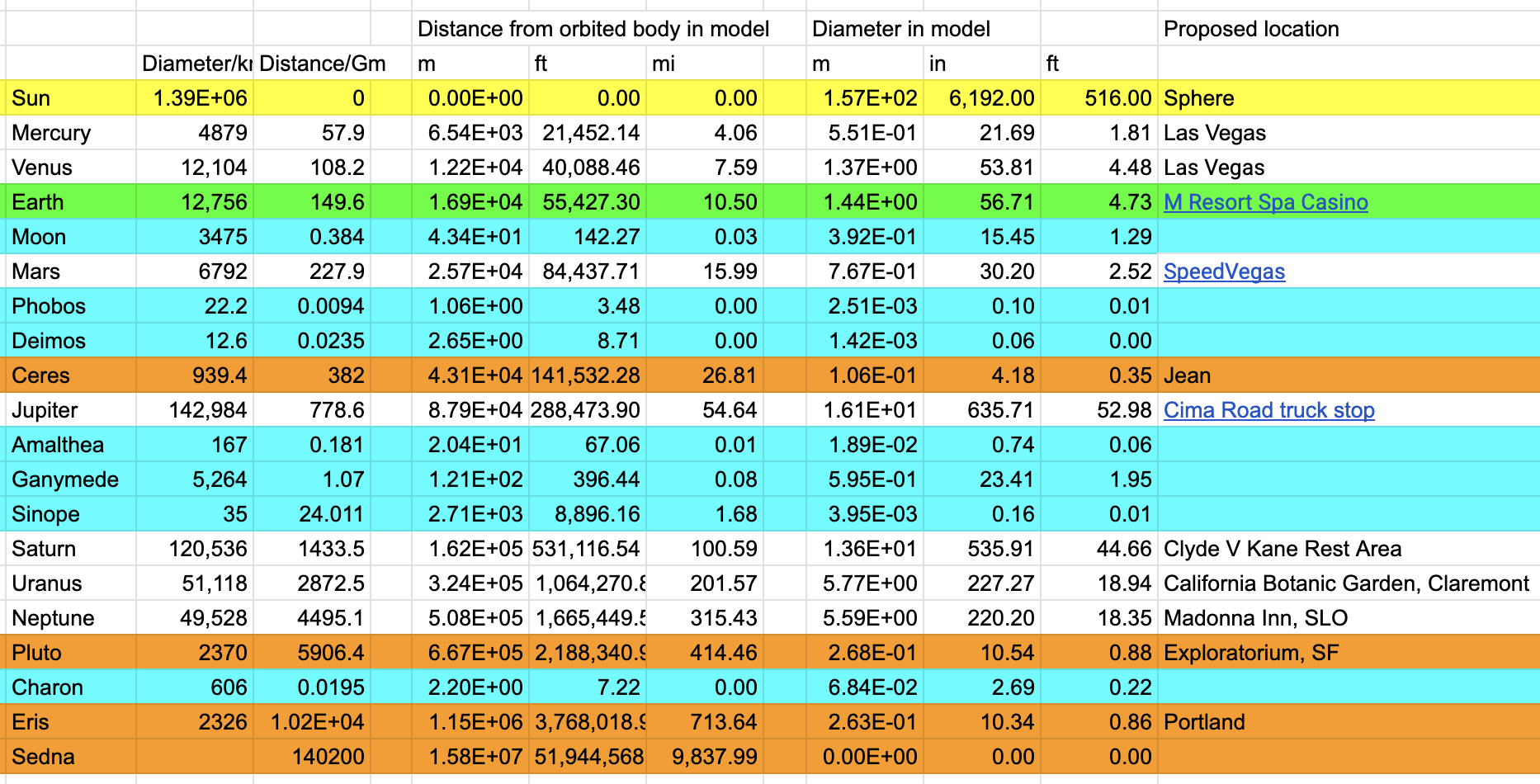
Sphere is 516 feet in diameter, implying an overall scale of 1:8.855 million, making the model over twice the size of that of Sweden. Even at this scale, most of the planets, dwarf planets and moons are surprisingly small. Earth is the largest non-gas-giant in the Solar System and would be represented by a sphere less than five feet across, about 10 ½ miles from the Sphere; there’s a convenient casino about the right distance and not far from the road towards LA. The Moon would then be a 15 inch sphere 142 feet from the Earth.

The four gas giants present a more serious challenge; even the smallest, Neptune, must be 18 feet across. While it’s preferable that all bodies be represented with spheres or hemispheres, in these four cases we might initially follow the example that the Sweden Solar System sets with Jupiter and Saturn, and use a circular representation at least initially. For example we could represent Jupiter as a painted circle, 53 feet in diameter, at the Cima Road truck stop. I’ve put the locations on a road trip from Vegas to SF via LA, since that should maximize visitability and also is most convenient for me. Note that the distances increase rapidly; while Mars can be placed near a race track just outside Vegas, Jupiter is already out of Nevada and into California. Uranus can be placed at a botanic garden in Greater Los Angeles, Neptune at a hotel in SLO, Pluto in the Exploratorium in SF, and Eris in Portland Oregon.

One convenient thing about this scale is that even relatively small astronomical bodies will be visible to the naked eye: for example, Mars’s moon Deimos will be a sphere slightly under 1/16 inch in diameter, around 9 feet from the 30 inch sphere representing Mars itself.

This spreadsheet details the diameter and distance each model needs to be to fulfil our chosen scale, and in most cases suggests a suitable location at roughly the right distance from the Sphere.

The relative distances in the solar system, and the vast space between its bodies, can be counterintuitive. Now that America has claimed the title of the world’s largest spherical building, a grand project to make this the center of the world’s largest scale model of the solar system is the perfect opportunity to capture the vastness of space.

Followup: What about Alpha Centauri? Photo credit: Sin City Las Vegas

Responses to Cade Metz’s hit piece on Scott Alexander

This depraved rubbish got quite a few responses. Please let me know about any I’ve missed. Inner bullets are subtitles or exerpts. Open to adding good Twitter threads too!

  • Scott Alexander, Statement on New York Times Article
    • I have 1,557 other posts worth of material he could have used, and the sentence he chose to go with was the one that was crossed out and included a plea for people to stop taking it out of context.
    • I don’t want to accuse the New York Times of lying about me, exactly, but if they were truthful, it was in the same way as that famous movie review which describes the Wizard of Oz as: “Transported to a surreal landscape, a young girl kills the first person she meets and then teams up with three strangers to kill again.”
    • I believe they misrepresented me as retaliation for my publicly objecting to their policy of doxxing bloggers in a way that threatens their livelihood and safety. Because they are much more powerful than I am and have a much wider reach, far more people will read their article than will read my response, so probably their plan will work.
  • Cathy Young, Slate Star Codex and the Gray Lady’s Decay [archive.org]
    • The New York Times hit piece on a heterodox blogger is a bad stumble — the latest of many
    • The New York Times has wandered into an even worse culture-war skirmish. This one involves bad (and arguably dishonest) reporting as well as accusations of vindictiveness and violation of privacy. It’s a clash pitting the Times against a prominent blogger critical of the social justice progressivism that has become the mainstream media’s dominant ideology in the past decade. The Times does not look good.
  • Robby Soave, What The New York Times‘ Hit Piece on Slate Star Codex Says About Media Gatekeeping
    • “”Silicon Valley’s Safe Space” has misinformed readers.”
    • It’s a lazy hit piece that actively misleads readers, giving them the false impression that Siskind is at the center of a stealth plot to infiltrate Silicon Valley and pollute it with noxious far-right ideas.
    • The idea that a clinical psychiatrist’s blog is the embodiment of Silicon Valley’s psyche is very odd
    • To the extent that the Times  left readers with the impression that Siskind is primarily a right-wing contrarian—and Silicon Valley’s intellectual man-behind-the-curtain to boot—it is actually the paper of record that has spread misinformation.
  • Matt Yglesias, In defense of interesting writing on controversial topics
    • Some thoughts on the New York Times’ Slate Star Codex profile
    • I think Metz kind of misses what’s interesting about it from the get-go.
    • something about the internet is making people into infantile conformists with no taste or appreciation for the life of the mind, and frankly, I’m sick of it.
  • Tom Chivers, When did we give up on persuasion?
  • Freddie deBoer, Scott Alexander is not in the Gizmodo Media Slack
  • Scott Aaronson, A grand anticlimax: the New York Times on Scott Alexander
  • Sergey Alexashenko, How The Hell Do You Not Quote SSC?
    • “The NYT misses the point by a light-year.”
  • Kenneth R. Pike, Scott Alexander, Philosopher King of the Weird People
  • Noah Smith, Silicon Valley isn’t full of fascists
  • Thread by Steven Pinker

NYT plan to doxx Scott Alexander for no real reason

UPDATE 2020-06-25: Please sign the petition at DontDoxScottAlexander.com!

The New York Times is planning on publishing an article about Scott Alexander, one of the most important thinkers of our time. Unfortunately, they plan to include his legal name. In response, Scott has shut down his blog, a huge loss to the world.

This will do enormous harm to him personally; some people hate Scott and this will encourage them to go after his livelihood and his home. Not all of them are above even SWATing, ie attempted murder by police. If he does lose his job, it will also “leave hundreds of patients in a dangerous situation as we tried to transition their care.”

However, the greatest harm is to the public discourse as a whole. Shutting people down in real life is an increasingly popular response to all forms of disagreement. Pseudonymity plays an essential role in keeping the marketplace of ideas healthy, making it possible for a wider spectrum of ideas to be heard. If the NYT policy is that anyone whose profile becomes prominent enough will be doxxed in the most important newspaper in the world, it has a chilling effect.

All this might be OK if there was some countervailing public interest defence,  if there was a connection between his blogging and his real world activity that needed to be exposed. But as I understand it, no-one is asserting this. The defence of this incredibly harmful act is simply “sorry, this is our policy”. It’s not even a consistently applied policy: a profile of the Chapo Trap House hosts published in February rightly omitted host Virgil Texas’s real name, though they must surely have been aware of it.

I urge you to spread the word on this everywhere you have reach, and to politely contact the New York Times through the means Scott outlines in his post to urge them to do the right thing.

UPDATE 2020-06-25: Please sign the petition at DontDoxScottAlexander.com!

Here’s the letter I wrote:

I am a subscriber, and I am dismayed to learn that the Times plans to doxx blogger Scott Alexander. In an age where people so often respond to disagreement by attacking someone in the real world, whether by getting them fired or by SWATing, pseudonymity plays an essential role in the marketplace of ideas, helping to ensure that a wide spectrum of voices can be heard. 

Obviously if there was a public interest defence of publishing this information – if there was a connection between his blogging and his real world activity that needed to be exposed – that would be different, but as I understand it no-one is asserting that. If you plan to do something so tremendously harmful to the public discourse as a whole, please have a reason other than “this is what we do”. You were right not to doxx Chapo Trap House host Virgil Texas; please apply that policy here.

Some more numbers as lambda calculus

On Reddit, u/spriteguard asks:

Do you have any diagrams of smaller numbers for comparison? I’d love to see a whole sequence of these.

I have work to put off, so I couldn’t resist the challenge. Like the previous post, these are Tromp diagrams showing lambda calculus expressions that evaluate to Church integers.

0
1
2
3
5
Multiplication: λa b f. a (b f)
10 (represented as 2 × 5)
100 = (2 × 5)^2
A googol
A googolplex
A googolduplex
Decker (10↑↑↑2)
Graham’s number
My own large number, f_{ω^ω + 1}(4) in a version of the fast-growing hierarchy where f_0(n) = n^n
A truly huge number, f_{Γ_ω + 1}(3)

Code to generate these diagrams is on Github; I generated these with the command

./trylambda --outdir /tmp/out demofiles/smallernums.olc demofiles/graham.olc demofiles/fgh.olc demofiles/slow.olc

A picture of Graham’s Number

One of the first posts I made on this blog was Lambda calculus and Graham’s number, which set out how to express the insanely large number known as Graham’s Number precisely and concisely using lambda calculus.

A week ago, Reddit user u/KtoProd asked: if I wanted to get a Graham’s Number tattoo, how should I represent it? u/FavoriteColorFlavor linked to my lambda calculus post. But in a cool twist, they suggested that rather than writing these things in the usual way, they use a John Tromp lambda calculus diagram. I got into the discussion and started working with the diagrams a bit, and they really are a great way to work with lambda calculus expressions; it was a pleasure to understand how the diagram relates to what I originally wrote, and manipulate it a bit for clarity.

The bars at the top are lambdas, the joining horizontal lines are applications, and the vertical lines are variables. There are three groups; the rightmost group represents the number 2, and the middle one the number 3; with beta reduction the two lambdas in the leftmost group will consume these rightmost groups and use them to build other small numbers needed here, like 4 (22) and 64 (43). The three is also used to make the two 3s either side of the arrows. Tromp’s page about these diagrams has lots of examples.

I’m obviously biased, but this is my favourite of the suggestions in that discussion. If u/KtoProd does get it as a tattoo I hope I can share a picture with you all!

Update: Some more numbers as lambda calculus

Update 2020-02-24: I’ve added the ability to generate these diagrams to my Python lambda calculus toy. After installation, try ./trylambda demofiles/draw.olc.